
.png)
You already did the hard part.
You built the academy. You launched the LMS. You shipped courses, lessons, videos, certifications, help content, and hands-on labs. You invested in instructional design, SMEs, and the systems to support all of it.
Many CE teams now have more content than they ever thought they would, whether it's outdated content gathering dust that desperately needs an audit or early Gen AI content that you might have clicked publish on too soon before you knew best practices.
Or, you may have just the right amount of quality content (a round of applause is coming your way!)
Either way, a familiar tension keeps showing up in CE and Digital Customer Success conversations.
- Learners (your must-retain customers) feel overwhelmed.
- Completion doesn’t always turn into confidence.
- Attention is shorter, expectations are higher, and “just in time” help is no longer optional.
- The idea of a static course is slowly dying, especially with the amount of learning content trapped in SCORM
Meanwhile, AI search tools like ChatGPT, Claud, and Gemini are increasingly where customers go first when they’re stuck. The issue isn’t content scarcity anymore. It’s guidance scarcity. And as we know, you can't afford to lose learner attention when it costs your company outcomes like customer churn.
The shift CE leaders are already living
Modern learners aren’t asking for more information. They’re asking for help navigating what already exists.
- They want to know where to start right now.
- What applies to their role, their product usage, their stage.
- What to do next when they’re stuck.
- And whether they can ask a question without digging through six courses and a forum thread.
This isn’t a rejection of structured learning. It’s a response to cognitive load and time pressure.
Large language models (LLMs) didn’t create this expectation, they exposed it.
When customers can ask a question in plain language and get a reasonable answer in seconds, every static content experience feels heavier by comparison. Not because it’s bad. Because it’s too slow, puts work on the user to synthesize and isn’t personalized .
The opportunity for CE and Digital Customer Success leaders isn’t to compete with AI on speed or volume.
It’s to use AI to guide learners through the experience you already designed.
From delivering content to guiding learners
For years, LMS success was measured by familiar metrics: courses launched, enrollments, completions, certifications issued. Those metrics still matter. But they were always proxies. Where do we go from here if we agree that we’re moving to a courseless world?
What leaders actually care about is…
- Whether customers can use the product effectively
- Solve problems faster, build confidence, and reach outcomes that drive retention and expansion.
In a world of limited attention and abundant information, the differentiator isn’t a bigger catalog. It’s the experience layer on top of the content.
It’s not just more learning. It’s smarter guidance so that just the right amount of learning actually lands.
A real step we’re taking today: AI Tutor in Skilljar
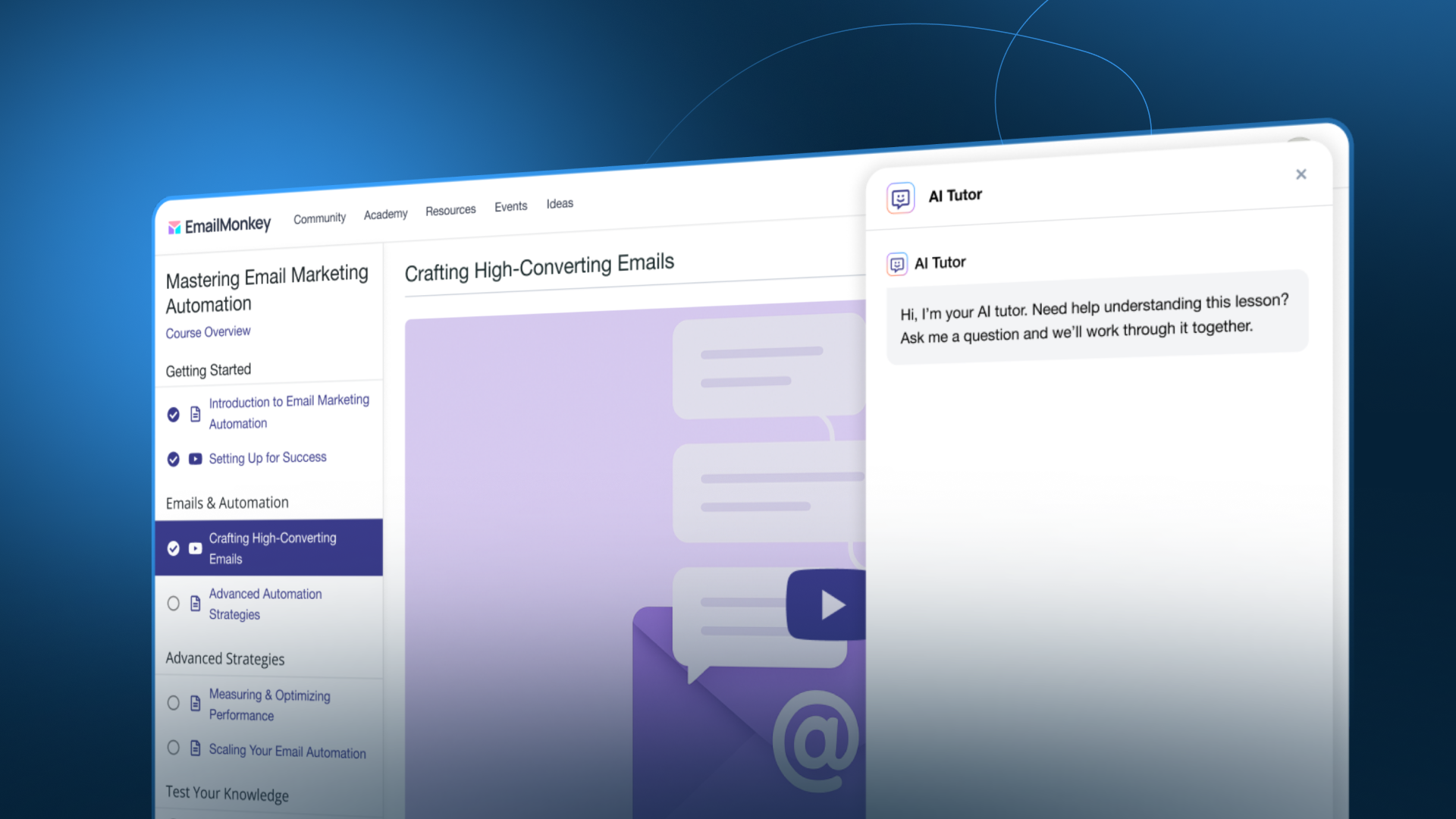
This is why one of the biggest steps we’re taking toward agentic learning right now is the open beta of AI Tutor, embedded directly in Skilljar’s LMS.
AI Tutor brings real-time, in-course guidance to learners using gen AI, right where learning actually happens.
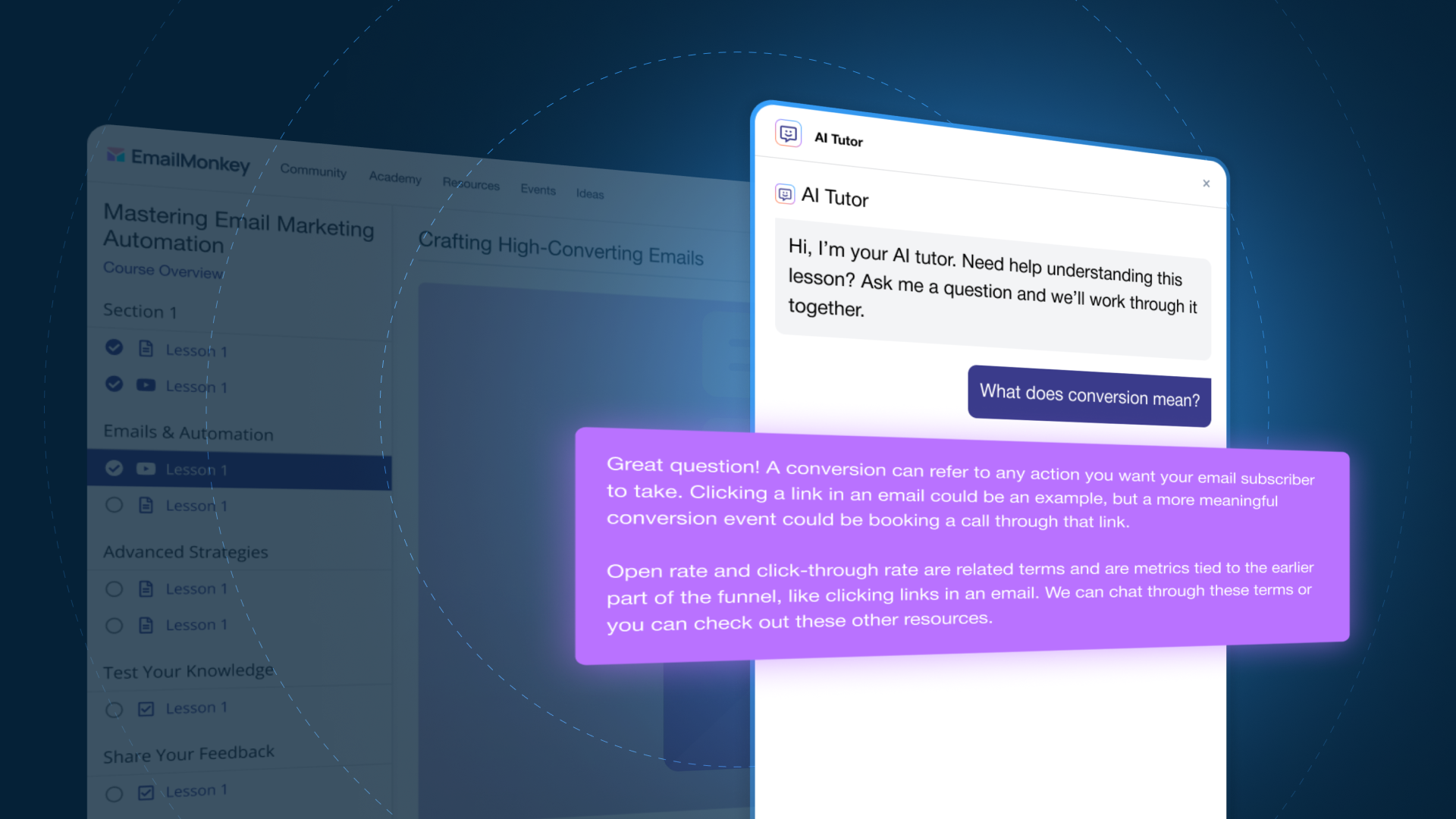
Instead of leaving the course to search, learners can ask questions in plain language and get instant, helpful responses. The AI doesn’t just answer. It guides learners to the next best step based on the course content and learning goals.
This matters because it shifts learning from something learners have to figure out to something that actively supports them as they go.
This open beta is more than a feature release. It’s a meaningful step in our investment in agentic learning, where education is proactive, personal, and embedded throughout the learner journey.
What “agentic learning” really means
Agentic learning can sound abstract or overly futuristic. It doesn’t need to. At its core, it’s the digital version of what great educators, onboarding specialists, and CSMs have always done instinctively.
They pay attention to who the learner is, it’s bidirectional. They notice what they’re trying to do. Like any good teacher, they adjust based on confusion, progress, or context. And they offer the next best explanation, example, or practice. AI tutors or learning assistants prompts the learner as much as the learner prompts them.
Agentic learning is the ability to do this digitally, at scale, and in the moment.
- Not only in live sessions.
- Not only for high-touch accounts.
- Not only for the most vocal learners.
But for everyone who shows up.
Why this is possible now
This shift isn’t about chasing a trend. It’s about finally having the right building blocks in place.
Most CE organizations have rich learner and product data, modular learning assets, transcripts, documentation, and community knowledge. Don’t worry, we know it’s not always easy to extract it—that’s another blog post.
And now, we have AI systems capable of understanding intent and context in plain language.
What’s been missing is the connective tissue. Agentic learning connects…
- Who the learner is
- What they’re trying to do
- Where they’re getting stuck
- and what content, regardless of where it lives, will help most right now.
This doesn’t replace your LMS. It activates it.
.png)
What agentic learning looks like in practice
In practice, agentic learning shows up in small, very human moments.
- A learner asks a question and immediately gets an answer and is guided to the right lesson…not a list of search results.
- An experienced user skips the basics and gets advanced guidance immediately.
- Someone struggling pauses, and the system adjusts with a shorter explanation or a different format.
The content hasn’t changed. The experience has.
Your content isn’t the finish line
This is a hard—but freeing—realization for many education teams. Creating great content is no longer the end game. It’s the raw material.
The real work now is designing for moments instead of linear paths. Making content reusable. Tagging it for intent, not just topic. And letting learners ask questions instead of guessing where to click next.
In this model, CE leaders aren’t just course publishers. They’re something akin to "experience architects." Of course we’ll see a laundry list of new job titles hit LinkedIn, but they all continue to pull you out of content creation alone and into orchestration.
Why digital success teams are uniquely positioned
No function understands customer context like customer education, community, and all "digital customer success" teams do.
You sit at the intersection of product reality, customer questions, learning behavior, and outcome metrics. Agentic learning isn’t a marketing experiment or a support deflection tactic; it’s a continuation of what great customer education has always been about.
Helping people succeed faster, with confidence.The difference now is that we can do it dynamically, personally, and at scale.
Ready to take Skilljar for a spin?
Take an interactive tour of Skilljar, or book your demo with our team.